
Autodesk Acquisition of MaintainX Impact on Construction Software

Construction Is Just One Stop For the Asset Lifecycle Train And You Better Get Onboard
One TLA flashed in my head when I saw the news of Autodesk acquiring MaintainX.
D. O. M.
I think it was ARC Advisory Group that coined the term Design, Operate, Maintain (DOM), and for various companies and bylines I’ve been writing regularly about that three-letter acronym (TLA).
Why? Because it treats the asset team as part of a continuum of value delivery rather than disembodied entities. Design for Maintenance and Operation (DFMO) is a related discipline, but really only focuses on design with the operational part of the lifecycle in mind.
A simple example of this is something I’ve seen in mechanical rooms where the mechanical contractor would weld a platform for tools at the stations where maintenance technicians would need to work and enable good latitude for larger techs to access equipment. On a broader level, we may see common fittings and fixtures used to reduce cost and complexity of sustaining the asset.
I always thought of DOM, however, in terms of data—how it flows from one step to the other, how visibility of project and asset data is preserved and how it underpins decisions along the way.
For an industrial facility, the value is obvious. At handoff, a project owner may get binders of data about the structure, equipment specifications and recommended maintenance regimens from original equipment manufacturers. But can that data come in a form that makes it easier to operationalize directly in a computerized maintenance management system (CMMS) or enterprise asset management (EAM) software?
Institutional and commercial project owners too will want to know how design decisions impact their lifecycle costs.
Even a homeowner who has built a deck will realize that maintenance cost will be higher for wood, while concrete may be more expensive up front. Now consider different building methods, materials, mechanical systems, roof systems, lighting, with lifecycle cost for maintenance, energy and operation. Something as mundane as light fixtures gain new significance when you consider energy lifecycle cost, bulb life, control part failure and other factors. Infrastructure projects will present various cost and lifecycle impacts from concrete mix, structural design, foundation systems and more. Designing with these considerations, ensuring priorities are preserved during value engineering, change orders and procurement demands a purpose-built computing environment.
After project handoff, that data should be used for projections, scheduling and to manage expectations. But no plan survives its implementation, and project and asset owners need to document:
Maintenance against the recommended schedule in terms of percentage of preventive maintenance complete
Reconfigurations or capacity enhancements
Qualifications and credentials of individuals and contractors involved in the asset
Claims against a project warranty
Performance and fault data
Financial metrics like revenue and margin for the asset over its lifecycle
Total cost of maintenance
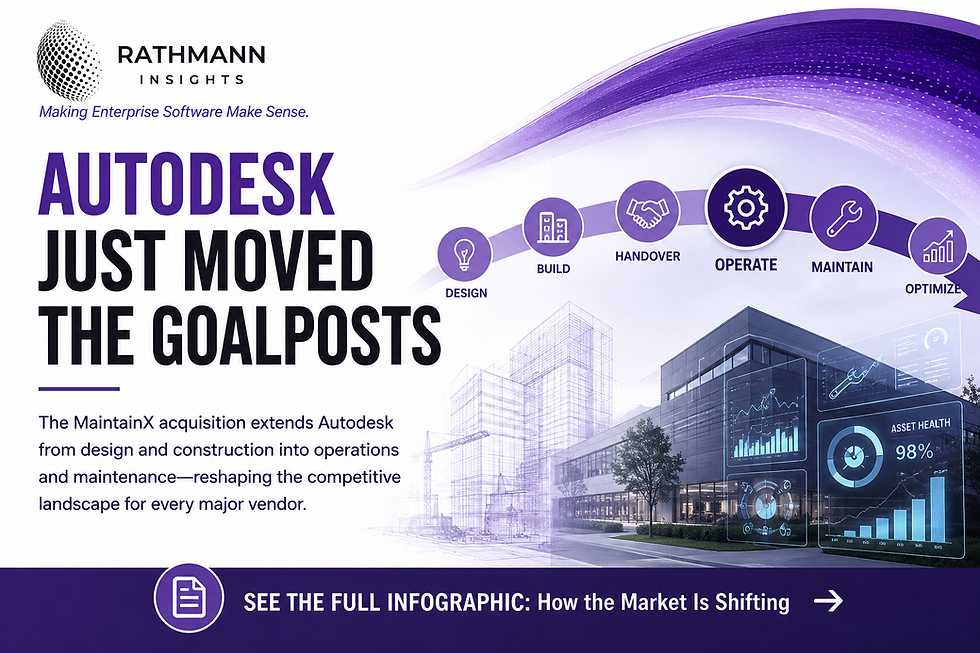
Applications like FORMA that keep a centralized asset data repository across the DOM lifecycle will help asset owners comply with the PAS 55000/PAS 55 standard. Now, with the addition of MaintainX, Autodesk goes deeper into the productive phase of the asset lifecycle.
Autodesk Acuisition of MaintainX = M in DOM
While enterprise applications from EAM to enterprise resource planning (ERP) will support the financial decision making that underpins the asset, work management for maintenance generally falls to outside applications. Why? Enterprise software starts at the general ledger, while the work order starts at the work face.
MaintainX meanwhile is widely used for work order management in maintenance, but also rolls data and process up into an enterprise solution that strings activities together into well-structure workflows and orderly industrial internet of things (IIoT) data streams that support decision making by people or artificial intelligence (AI).
Why do we care about what happens at the work face?
Well, the value of that asset depends directly on what happens here. Was the maintenance activity performed at all? What was done and by who? What parts or materials were consumed, down to serial traceability? Are there calibration, metrology, materials or other findings that should be recorded? The more visibility leadership has into the condition of the asset, the better they can maximize value while mitigating risk. Are PMs not performed, resulting in quality issues that lose customers at best and a legal and reputational liability at worst?
All of these affect the lifecycle of the asset. Unless asset and project owners can make decisions intelligently about total asset lifecycle value, they will make decisions that shorten productive life, lower throughput and diminish market value of asset outputs.
The question is--are contractors ready to participate in this asset lifecycle? As owner expectations around building information modeling (BIM) increase, as capital gets tighter, they will need to.
The availability of broad application suites that cut across the asset lifecycle may also lead to transparency that favors revenue sweeteners like operations and maintenance contracting: if an AEC team can deliver more efficient assets, it behooves them to be compensated based on asset performance.
But what do you think?



Comments